Humanitarian Media Center Releases New Report on Widening Humanitarian Gaps in Hadramout and Al-Mahra

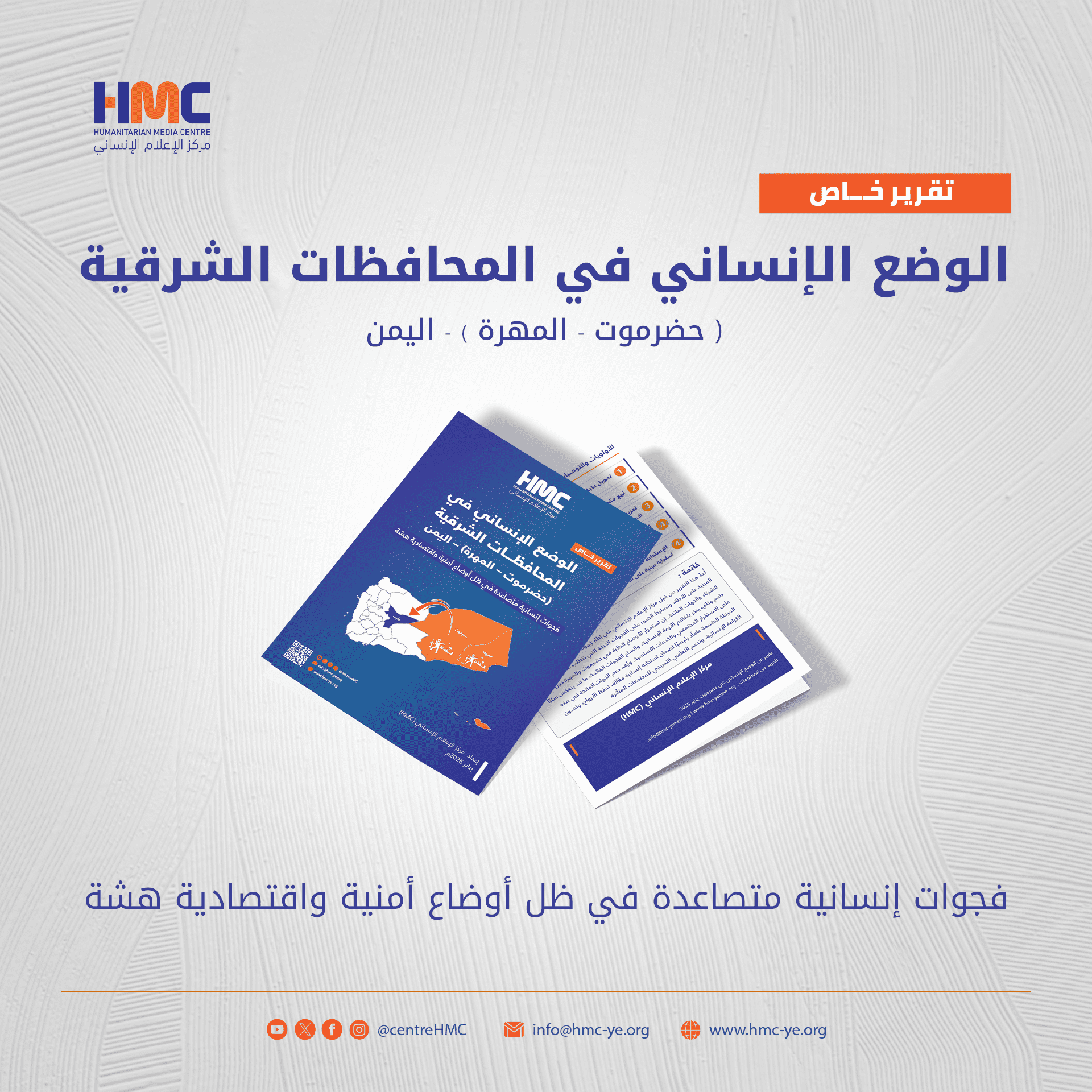
Humanitarian Media Center (HMC) has released a new humanitarian report highlighting the worsening humanitarian situation in Hadramout and Al-Mahra governorates amid fragile security and economic conditions, accompanied by waves of internal displacement and increasing pressure on basic services and infrastructure.
Covering developments from December 2025 through early January 2026, the report indicates that recent security escalations in Wadi Hadramout have triggered new waves of displacement, forcing thousands of families to leave their areas. A considerable number have moved toward Marib Governorate, further exacerbating the vulnerability of both displaced families and host communities.
According to the data presented in the report, a total of 1,228 households were verified as displaced from Hadramout to Marib as of December 21, 2025. During the reporting week (December 28, 2025 – January 3, 2026), 113 new displacements were recorded, with security-related conflict identified as the primary driver in 93% of the cases. The report further notes that shelter and housing were the most urgent needs among displaced families, followed by protection, financial assistance, and food support.
Regarding Al-Mahra, the report confirms that the governorate has been indirectly affected by the crisis due to the arrival of individual displacement cases and rising pressure on health facilities and basic services. Limited resources and poor infrastructure raise the risk of escalating humanitarian needs if the current situation persists.
The report underscores critical humanitarian gaps in key sectors including food security and livelihoods, health and nutrition, water, sanitation and hygiene (WASH), shelter, protection, and education. It warns that the ongoing response remains insufficient compared to the scale of growing needs, posing a direct threat to the lives and dignity of thousands of affected families.
The Humanitarian Media Center’s report concludes with a call for donors and humanitarian partners to provide immediate and flexible funding to support life-saving sectors and to strengthen multi-sectoral programs targeting displaced populations and host communities. Furthermore, the Center underscores the importance of investing in medium-term interventions that enhance community resilience and reduce reliance on emergency assistance.
The Center affirmed that the issuance of this report comes as part of its ongoing efforts to support evidence-based humanitarian response and to contribute to improved planning and decision-making, thereby helping prevent further deterioration of the humanitarian situation and preserving social stability in Yemen’s eastern governorates.